Commission approves Clinton landfill closure site plan
The Clinton Planning and Zoning Commission approved a conditioned site plan for closing the town's long-idle Old Nod Road landfill, even though the state has not yet issued a final closure permit.
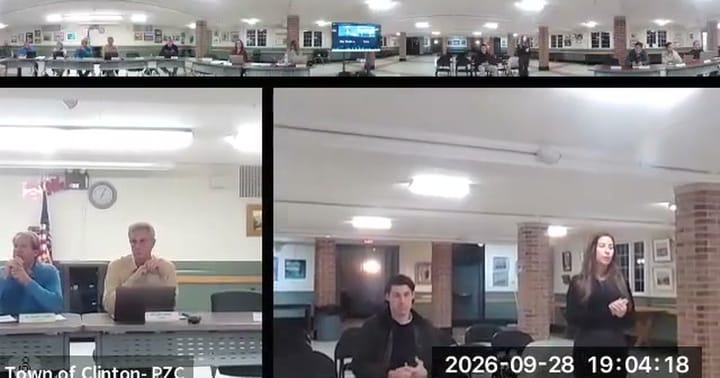
Planning and Zoning · Meeting of September 29, 2026
CLINTON — The Clinton Planning and Zoning Commission approved a conditioned site plan for closing the town's long-idle Old Nod Road landfill, even though the state has not yet issued a final closure permit. Chairman Michael Rossi presided as the board adopted 15 conditions limiting construction hours to 7:30 a.m. to 5 p.m. weekdays, truck hours to 8 a.m. to 4 p.m. weekdays, and eliminating previously planned Saturday work. Emily Kelting of Lorero Engineering Associates told the panel fill volume has dropped from an original 132,000 cubic yards to roughly 112,000 cubic yards of fill plus about 30,000 to 32,000 cubic yards of cover material.
The board capped individual stockpiles at 17,000 cubic yards and required removal of all stockpiled material if the Connecticut Department of Energy and Environmental Protection permit is not issued within six months. Member Michael Florio said of the project, "one way or another, this thing's going to get done." Both the hearing-closure vote and the site plan approval passed unanimously.
In the full story:
- Who Was There
- Organizations And Documents Referenced
- The complete report — 2,036 words
Source: the Planning and Zoning meeting of September 29, 2026, reported from the official video recording and transcript.
The Full Article
Continuation of the Public Hearing: PZC 26-15
The hearing on application PZC 26-15, the site plan for capping and closing the former Clinton landfill on Old Nod Road, has stretched across several meetings. Chairman Michael Rossi told the panel at the outset that no new public notice was needed because this was a continuation, and that the night's purpose was largely to get "final information from the legal counsel" before deciding whether to close the hearing. The landfill has sat under a Connecticut Department of Energy and Environmental Protection consent order, case number WC4956, since 1990, according to the findings of fact the commission later adopted. The question before the commission was narrow but consequential: did it have enough information to close the hearing, and if so, would it approve a conditioned site plan even though DEEP's final closure permit had not yet arrived.
State Review Status and the Fill Volume Question
Emily Kelting of Lorero Engineering Associates, the firm under contract to the town to design and manage the closure, updated the board on the state side of the process. She said the team submitted a response-to-comments package to DEEP after the commission's prior meeting, addressing three outstanding items: two questions about the grading plan and one about monitoring potable wells. DEEP asked why the project proposed the amount of fill that it did; Kelting explained that more fill produces more primary settlement during construction, which the town wants completed before any future redevelopment of the capped landfill, reducing settlement risk for whatever structures might eventually go there.
Separately, commission members pressed on a volume figure that had shifted across meetings. The site's original closure documents listed 132,000 cubic yards of material. Kelting said that number has since dropped to 112,000 cubic yards of fill plus roughly 30,000 to 32,000 cubic yards of cover material, a change she attributed to relocating four stormwater detention basins outside regulated wetland areas to avoid wetlands impact. Commission members at different points in the discussion referenced both a 20,000-cubic-yard reduction and, from Kelting directly, "about 30,000 yards" as the amount removed from the plan. The discrepancy was not fully reconciled on the record; Kelting said she did not anticipate the total rising again and that the current figures reflect the most recent DEEP submission.
"So the final number of cubic yards of material has not been firmly established yet. Is that understanding correctly?" one member asked. Kelting replied that the number was "updated with our recent submission to the state" and would not increase, though she could not rule out a modest decrease depending on DEEP's final review.
The Environmental Attorney's Recommendations
A staff planner identified in the meeting only as Abby relayed findings from the commission's consulting environmental attorney, Lee Hoffman of the firm transcribed in the meeting as Pullman & Colby. Hoffman flagged three issues for the record. First, he wanted the commission's record to clearly document the final shape and height of the capped landform: an average rise of about eight feet across the site, with a maximum difference of roughly 20 feet at the highest point, and vegetative buffers that sit on private property and may not provide full seasonal screening since their composition of deciduous versus evergreen plantings is not fully known. Abby told the commission this was neutral information for the record, not a judgment on the project.
Second, Hoffman recommended the commission spell out clear operational terms and third-party oversight requirements, covering hours, lighting, and traffic, which Abby said fall squarely within the commission's site-plan and zoning authority even though DEEP controls what materials can come onto the site and in what total volume. Third, if the commission chose to let Lorero stockpile material before DEEP issues its final permit, Hoffman recommended limiting individual stockpile sizes rather than allowing one large pile, suggesting roughly 17,000 cubic yards per pile instead of a single 50,000-cubic-yard mound, the maximum DEEP has already authorized for the site overall.
Closing the Public Hearing
With that information in hand, and no members of the public present to comment (the lone attendee beyond commission members and staff identified himself as working for Lorero), the commission voted on a motion, moved and seconded without recorded objection, to close the public hearing. The vote was unanimous.
The Stockpiling Debate
Discussion then turned to the site plan itself, centered on whether to let Lorero begin bringing in and stockpiling fill before DEEP's final closure permit is issued. Rossi said he had gone "back and forth" and was "agnostic." Member Tunzee Lettieri, referred to later in the discussion as Chintzy, asked whether there was any benefit to waiting for DEEP's final word before allowing stockpiling to begin. Abby responded that the only plausible downside would be if DEEP's permit came back requiring less total fill than planned, which would not conflict with an early, smaller stockpile, since DEEP is not expected to reject the closure outright after supporting it since 1990.
Member Michael Florio argued delay would not meaningfully protect the town: "One way or another, this thing's going to get done, correct? ... So I don't know what the big deal is." Member Zach Lord said allowing earlier stockpiling could actually ease a concern raised in earlier public comment about truck traffic, since starting deliveries sooner could spread them out and reduce daily truck counts. No member spoke against allowing stockpiling, and the board proceeded on that basis.
Bonding and Financial Assurance
Member Robert Corson raised whether the commission could require a bond covering removal of stockpiled fill if the project were abandoned or delayed. Abby said bonding is not currently part of the town's contract with Lorero and would require separate negotiation between the town council and the firm; the commission's own authority extends to conditioning approval, including requiring a bond set by the town's engineer, a practice Abby said has precedent, but not to compelling the town to renegotiate its contract. The commission ultimately did not include a dollar-denominated bonding requirement in its approved conditions, leaving that question, if pursued, to the town council.
Drafting the Conditions and Findings of Fact
After a five-minute recess to read a draft decision, the commission worked through editorial changes with member Ellen Dahlgren, who asked that the Connecticut Department of Energy and Environmental Protection be spelled out on first reference and abbreviated "CTDEEP" thereafter, that NPDES be spelled out once, and that the engineering firm's name be spelled out and abbreviated "LEA" for consistency with the rest of the conditions. Dahlgren also asked that a lighting condition simply require compliance with "our regulations" rather than specifying a particular foot-candle standard, which the board adopted.
The approved conditions, read in full by Rossi, require: third-party construction oversight selected through the town's procurement process, covering road-condition documentation, storm-water facility review and construction-phase inspections; an initial road-condition assessment before site mobilization, with LEA responsible for restoring the site entrance and Old Nod Road within 100 feet if damaged; clearly marked limits of work; stockpiling permitted in piles not exceeding 17,000 cubic yards each, with all stockpiled material to be removed and the area restored, including soil testing showing no remaining contaminants, if DEEP's final closure permit is not issued within six months of the first fill delivery; compaction standards reviewed by the town's third-party consultant before grading begins; immediate notification if waste material is found outside the property line; construction hours of 7:30 a.m. to 5 p.m. and truck hours of 8 a.m. to 4 p.m., Monday through Friday, with no Saturday work; a prohibition on trucks queuing or parking on town property outside those hours; site lighting that complies with Clinton zoning regulations; a pre-construction meeting with the town, including the zoning enforcement officer, at least two weeks before work begins, with the required vehicle tracking pad installed before other site work; a final closure report within 90 days of completion; and post-closure monitoring and land-record notifications filed with the town.
Dahlgren also asked why the plan dropped previously discussed Saturday construction hours. Abby said the removal reflected concerns the commission itself had raised in earlier public hearings about weekend disruption in residential neighborhoods. Member Andrew Randi said he agreed with dropping Saturday work, noting the town's roads are already busy with residential and recreational traffic in summer.
Vote and Outcome
Rossi read 14 collective findings of fact into the record, including that the landfill operates under the 1990 consent order (WC4956), that DEEP has approved the project's material acceptability protocol with conditional stockpile authorization up to 50,000 cubic yards, that DEEP has approved the project's NPDES construction stormwater permit, that the Clinton Inland Wetlands Commission approved a companion wetlands application on July 7, 2026, and that, as of September 28, 2026, the required DEEP closure permit "has not been issued." The commission adopted the motion to approve PZC 26-15 with the 15 conditions and 14 findings, on a unanimous vote with no recorded opposition or abstention. A motion to adjourn followed and passed unanimously.
Rossi noted a 15-day appeal period begins once the written decision is published, which he said the commission would issue "right away."
What Happens Next
The approval lets Lorero begin site work, including limited stockpiling, while DEEP's final closure permit remains pending. If that permit differs substantially from the approved plan, commission regulations would require the applicant to return for a site plan amendment rather than proceed administratively. The town council, not the commission, would need to separately negotiate any bonding arrangement with Lorero if one is pursued later.
Michael Rossi, Chairman, Planning and Zoning Commission Bo Clark, member Ellen Dahlgren, member Robert Corson, member Michael Florio, member Tunzee Lettieri, member (also referred to once in discussion as "Chintzy") Zach Lord, member Dylan Walter, member Andrew Randi, member Susan Marcus, member — absent Jay Mendel, member — did not answer roll call; seat filled for this meeting by alternate Brian Pellegrini Brian Pellegrini, alternate, seated for Jay Mendel
Staff member identified only as Abby, role not specified in the available sources, presented the environmental attorney's findings and staff report.
Emily Kelting, Lorero Engineering Associates (firm name transcribed variously as Lorero, Larrero, Loreo and Guerrero), representing the applicant, the town of Clinton, in its capacity as contractor for the landfill closure.
Lee Hoffman, consulting environmental attorney, firm transcribed as Pullman & Colby, cited by staff but not present to speak directly.
One unnamed individual present in the audience identified himself as working for Lorero when asked whether anyone from the public wished to comment; no members of the public spoke.
Connecticut Department of Energy and Environmental Protection (DEEP/CTDEEP) — issuer of the 1990 consent order governing the landfill, reviewer of the pending closure permit, and approver of the material acceptability protocol and NPDES construction stormwater permit cited throughout the hearing.
Lorero Engineering Associates — engineering firm under contract with the town of Clinton to design and manage the landfill closure; presented updates on the state permitting process and the stockpiling proposal.
Pullman & Colby (as transcribed) — law firm of the commission's consulting environmental attorney, Lee Hoffman, whose recommendations on record-keeping, operational conditions and stockpile limits shaped the final motion.
Clinton Inland Wetlands Commission — approved a companion wetlands application, IWC 26-5, for the landfill closure on July 7, 2026, cited as a finding of fact supporting the site plan approval.
Clinton Town Council — authorized funding for the independent third-party review condition and would need to separately negotiate any bonding arrangement with Lorero.
Consent order WC4956 — the 1990 Connecticut DEEP consent order establishing the town's obligation to close the landfill, cited as the first finding of fact.
Solid waste closure plan for Old Nod Road landfill, prepared by Lorero Engineering Associates, dated August 22, revised through September 2026 — cited as a governing record document in the motion.
NPDES construction stormwater general permit, number CTR 100321, issued June 30, 2026 — cited as a governing record document.
Material acceptability protocol, approved by CTDEEP, revised through March 26, including conditional stockpile authorization of up to 50,000 cubic yards — cited repeatedly as the ceiling the commission could not exceed.
Share this story
Know someone in Clinton who follows town government? Share Townbrief Clinton: they can sign up free.