Clinton P&Z continues landfill hearing to Sept. 28
Clinton Planning and Zoning continued its hearing on the Old Knot Road landfill closure to a September 28 special meeting.
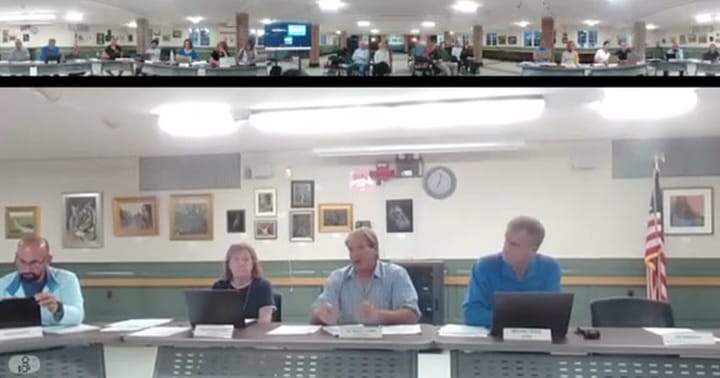
Planning and Zoning · Meeting of September 15, 2026
Clinton Planning and Zoning continued its hearing on the Old Knot Road landfill closure to a September 28 special meeting. Engineer Emily Kelting of Lerero Engineering asked to begin mobilizing equipment and stockpiling up to 50,000 cubic yards of fill before the state issues a final closure permit, saying the firm's attorney would accept liability for removing any imported soil if the permit does not come through. The commission, chaired by Michael Rossi, also approved a coastal site plan for a flood-zone cottage remodel at 3 Causeway, a restoration plan for a conservation-easement violation at 87 Killingworth Turnpike, and a modified site plan letting Clinton Premium Outlets install "no more than 10 storage trailers of no more than 100 square feet each." Resident James Gardner asked whether trucks would "use Old Knot exclusively to bring that much material," prompting assurances of an anti-tracking pad and phased construction.
The commission also scheduled an October 5 public hearing on a zone map change at 31 Old Post Road.
In the full story:
- Who Was There
- Organizations And Documents Referenced
- The complete report — 2,810 words
Source: the Planning and Zoning meeting of September 15, 2026, reported from the official video recording and transcript.
The Full Article
Minutes and regional housing discussion
The commission opened by reviewing minutes from its August 17 special meeting, which Chairman Michael Rossi said he had reviewed online since he was not present that evening. Rossi flagged a comment from commissioner Ellen Dahlgren about a shortage of "nice rentals" in town, tying it to the commission's ongoing review of regional housing strategy. "I think Ellen kind of hit the nail on the head with, we have to look at alternatives besides 8-30g for rentals," Rossi said, referencing Connecticut's affordable housing land use appeals statute, which the transcript renders as "A30G." The minutes were approved unanimously with no changes. This was a brief procedural item, but it set up a later agenda item on the housing needs assessment letter and signaled an ongoing commission interest in rental housing options beyond the state's affordable-housing statute.
Coastal site plan, 3 Causeway (PZC 26-16)
Background and stakes: The application sought to remodel an existing residential cottage in a coastal flood zone, requiring compliance with Section 17 of the zoning regulations governing substantial improvements to structures in flood hazard areas.
The question before the body: Whether to receive and approve the coastal site plan given that renovation costs fell under the 50 percent threshold that would otherwise require full flood-elevation compliance.
Substantive content: Applicants Joseph and Deborah Susco presented plans, prepared by a firm the transcript renders as "Basic and Associates," to remove the roof and second floor of their cottage, lift the first floor to install helical piers, and rebuild to the existing elevation. Land use staff noted the property sits in flood zone AE12 within the limit of moderate wave action, and that the Department of Energy and Environmental Protection had raised concern that the project could be used to add bedrooms, increasing density in the flood plain. The property is permitted for three bedrooms as a seasonal dwelling.
The deliberation: A staff presenter walked through DEEP's comments and recommended conditions, including a requirement that any five-foot egress opening on the new second floor not be used as a bedroom, and that an as-built plan confirm compliance with approved elevations and setbacks. One commissioner asked about erosion and sediment controls; staff and the applicant explained that minimal soil disturbance was expected because the work involves helical piers drilled into existing ground rather than earth-moving equipment.
Procedural steps and outcome: The commission voted unanimously to receive the application, found it eligible for a same-night decision, and then voted unanimously to approve it with the two conditions and four findings of fact described above, including a finding that the project is consistent with Connecticut General Statutes Section 22a-92, the Coastal Management Act.
Implications and what is next: The Suscos can proceed with permitting; the bedroom-use condition and as-built plan requirement will be verified before a certificate of occupancy is issued.
Restoration plan, 87 Killingworth Turnpike
Background and stakes: The property is subject to a declaration of perpetual conservation restriction recorded in the Clinton land records. Tree cutting, grading and an unpermitted septic system installation in the regulated area violated that declaration. The Inland Wetlands Commission approved a restoration plan at its September 1 meeting, but the declaration requires planning and zoning approval as well.
The question before the body: Whether to approve the restoration plan, prepared by Double D Design LLC, and set enforceable monitoring terms and a start date.
Substantive content: The plan includes a split-rail fence to reinforce a 50-foot buffer and a planting plan for the disturbed area. A soil scientist selected plantings suited to the site. The Inland Wetlands Commission's own decision cited a three-year monitoring period, which commissioner inquiry revealed had been omitted from the draft motion presented to this commission; staff corrected the condition language to match, specifying inspections every other month in year one and every six months for two years after.
The deliberation: A commissioner pressed for a hard start date rather than open-ended language tied to septic approval timing. "I think what I'm always asking for is a date certain that it will not start later than," the commissioner said, prompting the applicant's agent, Tony Balberg, to note the property owner still needs wetlands approval for a related septic system before restoration work can begin. The commission settled on requiring work to start no later than May 1, 2027, even though Balberg said the goal is to begin as early as November 2026.
Procedural steps and outcome: The commission voted unanimously to receive the matter and then voted unanimously to approve the restoration plan with conditions requiring zoning enforcement officer sign-off at completion, three years of monitoring, erosion controls until 75 percent vegetative cover is reached, annual documentation, and a filing of the decision in town land records.
Implications and what is next: The property owner must first secure wetlands approval for the septic system, expected at the October wetlands meeting, before the restoration clock starts; the May 2027 deadline is now the outer boundary regardless of how long that approval takes.
Zone map change and CAM application, 31 Old Post Road (PZC 26-19 and 26-23)
This was a short, procedural item. The applicant, working with Double D Design, is requesting a zone map change to consolidate a single-family property currently split across three residential zones into one zone, aligning zone lines with property lines rather than crossing through the lot. One commissioner recused from the application and did not participate in the vote; the transcript does not identify the recusing member by name. The commission voted unanimously to receive the zone map change application and schedule a public hearing for October 5, and separately voted unanimously to receive a related coastal area management application on the same site, to be acted on only after the full public hearing. One commissioner noted an expected absence on October 5 and asked whether that required abstaining from tonight's receive-only vote; staff clarified no abstention was necessary for a receiving motion.
Site plan modification, Clinton Premium Outlets storage trailers (PZC 26-20)
Background and stakes: The outlet center's original site plan approval, number 94-366, did not contemplate permanent on-site storage trailers. Retailers had been using temporary storage pods that come and go, often requiring off-site trips to retrieve merchandise.
The question before the body: Whether to approve a site plan modification allowing designated, permanent trailer storage in existing parking areas.
Substantive content: Kathleen Monas, general manager of Clinton Premium Outlets, said the center wants to place up to 10 storage trailers, roughly 8 feet by 12 feet each, in a rear-facing area not visible to customers, to be leased to five or six tenants needing overflow or seasonal storage space. She said the fire marshal preferred permanent, designated placement over scattered temporary pods because it keeps apparatus access clear. The trailers will be unbranded, resembling standard shipping or "mini-pod" containers, with no additional illumination.
The deliberation: A commissioner asked about total square footage; Monas estimated roughly 960 square feet across 10 units. Another commissioner suggested the motion specify a cap on trailer count and size rather than relying on the term "storage trailers" alone, since shipping containers come in varying standard sizes. The commission agreed to cap the approval at 10 trailers of no more than 100 square feet each.
Procedural steps and outcome: The commission voted unanimously to receive the application and, after amending the motion to add the trailer-count and size cap, voted unanimously to approve the modification with three findings of fact tied to consistency with the original 94-366 site plan and no impact on circulation, landscaping, lighting or parking.
Implications and what is next: Clinton Premium Outlets can now install the trailers and begin leasing storage space to tenants under the capped terms.
Regulation text amendment, Section 4.39.3(b)
A brief item: the commission voted unanimously to schedule an October 5 public hearing on a self-initiated amendment removing a mailed-notice requirement for commission-initiated zone map amendments.
Draft 2025-26 annual report
The commission reviewed and voted unanimously to approve a draft annual report. One commissioner used the discussion to credit the land use department's software system for handling an increased workload, without further debate.
Continued public hearing: Old Knot Road landfill closure (PZC 26-15)
Background and stakes: This is the town's project, under contract with Lerero Engineering, to cap and close the Old Knot Road landfill. The hearing, continued from at least two prior sessions, has drawn questions from the commission, the town council and the town's environmental attorney about liability, timeline and independent oversight.
The question before the body: Whether to allow Lerero Engineering to begin mobilizing equipment and stockpiling imported fill material before the state issues a final individual closure permit, and whether to continue the hearing to resolve outstanding legal and procedural questions.
Substantive content: Emily Kelting, a licensed professional engineer and project manager with Lerero Engineering, presented a visual demonstration using sightline boards for four neighboring properties — along Old Knot Road and East Shore Drive — and a fifth vantage point from the road itself, showing a six-foot-tall person's projected view before and after final grading, which raises the site's average grade about 8 feet. She said mature tree lines at each location, which will not be disturbed, will continue blocking views of the capped landfill. Kelting said Lerero holds two state approvals already: a material acceptability protocol allowing stockpiling of up to 50,000 cubic yards, and a construction stormwater general permit allowing site mobilization. She said the firm's attorney drafted a letter stating Lerero would be liable for removing any imported soil if the state's closure permit ultimately does not issue.
The deliberation: A land use staff member, identified in the meeting only by the first name Abby, told the commission the town's consulting environmental attorney had not yet reviewed Lerero's liability letter, and that any conditional approval would need to specifically define what is allowed and when. A commissioner raised a legal question about whether the commission could legally extend its statutory decision timeline for this type of application: "Because the statutes kind of limit it otherwise," the commissioner said. Staff responded that the town attorney's opinion holds that case law permits an extension when the applicant and a mutually interested town project agree to it, even though the statute's enumerated extension grounds do not list this scenario explicitly. A commissioner pressed on stockpile size and erosion controls during heavy rain; Kelting said Lerero's practical stockpile cap is about 20,000 cubic yards with double-row silt fencing, even though the state-approved protocol allows up to 50,000 cubic yards, clarifying this would mean one area managed within that erosion-control capacity rather than one giant pile.
During public comment, resident James Gardner, who said he lives near the site, asked whether trucks would exclusively use Old Knot Road and whether truck traffic would track contamination onto the street or cause stormwater runoff into storm drains during heavy rain. Kelting said an anti-tracking stone pad will be installed at the site entrance, that the project will be phased from the back of the site toward the road to minimize trucks driving over newly delivered material, and that final stormwater controls are designed to handle a 100-year storm event, with temporary sedimentation controls in place during construction. Staff separately described a pending third-party inspection program, funded through a town account transfer and awaiting a final procurement quote, to independently monitor material documentation, conduct site inspections, and assess road conditions before, during and after construction; the town's Water Pollution Control Commission already conducts ongoing well-water quality monitoring that would extend to cover new test wells installed for the project.
Procedural steps and outcome: The commission did not vote on the mobilization or stockpiling request at this meeting. It voted unanimously to continue the public hearing to September 28 and to schedule a special meeting at 7 p.m. that date to consider a conditional approval, pending the town attorney's review of Lerero's liability letter. Commissioners indicated general comfort with allowing stockpiling to begin before the state's final permit issues, subject to the liability terms being finalized, but confirmed no staging or stockpiling would occur before September 28 regardless.
Implications and what is next: The September 28 special meeting is the next decision point; it will determine whether Lerero can begin importing and stockpiling fill material before DEEP's final closure permit issues, what liability protections apply, and what independent oversight conditions attach to the project.
Committee reports: accessory apartments and POCD implementation
A Regulations Committee report introduced, without a vote, a plan to revise zoning provisions governing accessory apartments, which currently require a 40,000-square-foot lot for a special exception in business districts — nearly an acre — and include an annual self-certification requirement to the zoning enforcement officer that commissioners said has gone unenforced "for decades." Commissioners linked the issue to the town's Plan of Conservation and Development goal of a more vibrant downtown and agreed to develop draft regulatory language for the October 5 meeting. Separately, commissioners discussed outreach to the Harbor Management Commission, the Economic Development Commission and the Conservation Commission to align POCD implementation priorities with the commission's ongoing zoning regulation update, for which an RFP is already out. No votes were taken on either topic.
Correspondence: Red Wing and Long Hill Road
Rossi raised resident correspondence concerning Red Wing, an entity holding roughly seven undeveloped lots on Long Hill Road, which neighbors believe is preparing to build on at least three parcels neighbors expected to remain open space. Staff and Rossi explained that no deed restriction or land record evidence supports an enforceable open-space obligation, and that the matter falls outside the commission's and the zoning enforcement officer's authority, resting instead with private legal questions about the entity's incorporation documents. No vote was taken; commissioners agreed to continue raising such correspondence publicly "so that... there are (no perception of) backroom deals."
Bond release: the Hammocks
A brief update: land use staff is reviewing as-built documentation, working with a person named Mark Richards, to confirm the original subdivision's monumentation requirements before bringing a bond-release vote back to the commission. No vote was taken.
Housing needs assessment letter
Before adjourning, the commission confirmed consensus on the content of a housing needs assessment letter addressed to an entity the transcript renders as "Riverhog," possibly a regional council of governments, and voted unanimously to approve sending it.
Michael Rossi, Chairman, present. Bo Clark, member, present. Ellen Dahlgren, member, present. Robert Forsen, member, present. Michael Florio, member, present. Chinzy Lettieri, member, present. Jay Mandel, roll-call status unclear in transcript (no recorded response). Zach Plourd, member, present. Dylan Walter, member, present. Andrew Brandy, member, present. Susan Marcus, member, present. Brian Pellegrini, member, absent (stated unable to attend). Land use staff member identified only as "Abby," provided regulatory guidance throughout the meeting. Joseph and Deborah Susco, applicants, 3 Causeway coastal site plan. Tony Balberg, agent for the applicant, 87 Killingworth Turnpike restoration matter. Emily Kelting, licensed professional engineer and project manager, Lerero Engineering, representing the Old Knot Road landfill closure project. Kathleen Monas, general manager, Clinton Premium Outlets, storage trailer site plan modification. James Gardner, public comment, resident near the Old Knot Road landfill site.
Lerero Engineering — contracted by the town to design and oversee the Old Knot Road landfill closure; sought conditions allowing early mobilization and stockpiling. Connecticut Department of Energy and Environmental Protection (DEEP) — holds authority over the landfill's individual closure permit, material acceptability protocol and construction stormwater general permit; also raised bedroom-density concerns in the 3 Causeway coastal review. Double D Design LLC — prepared the restoration plan for 87 Killingworth Turnpike and site materials for the 31 Old Post Road zone map change. Clinton Inland Wetlands Commission — approved the underlying restoration plan at its September 1 meeting and recommended a three-year monitoring period later incorporated into the zoning decision. Connecticut General Statutes Section 22a-92 — Coastal Management Act provision cited as a basis for approving the 3 Causeway coastal site plan. Clinton Zoning Regulations Sections 17 and 27.1 — cited for flood-compliance thresholds and coastal site plan procedure. Clinton Plan of Conservation and Development (POCD) — cited in the accessory apartment regulation discussion and in planned outreach to the Harbor Management Commission, Economic Development Commission and Conservation Commission. Clinton Premium Outlets — applicant for the storage trailer modification, referencing original site plan approval number 94-366. Red Wing — entity holding undeveloped Long Hill Road lots, subject of resident correspondence about open-space expectations; commission found no enforceable zoning authority over the dispute. Connecticut General Statutes Section 8-30g (rendered in the transcript as "A30G") — the state's affordable housing land use appeals statute, referenced in discussion of regional rental housing strategy. Water Pollution Control Commission (WPCC) — conducts ongoing well-water quality monitoring near the landfill, to be expanded to new test wells.
Share this story
Know someone in Clinton who follows town government? Share Townbrief Clinton: they can sign up free.